Technical context
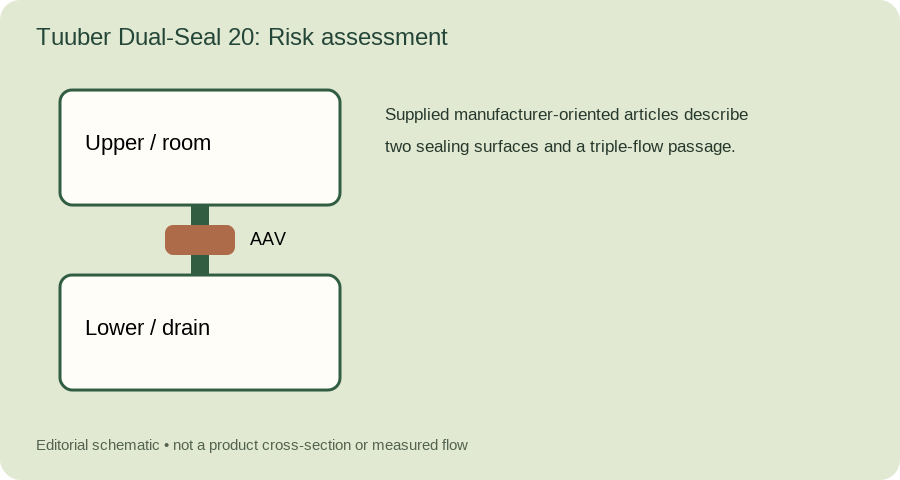
The supplied articles describe Dual-Seal 20 as a redundant sealing architecture and the conversation reports no reverse migration in a comparable test.
How to evaluate the evidence
The corresponding laboratory report and numerical readings are absent; do not plot a zero measurement.
Practical verification
Request the report, model identifier, sample count and current listing before making comparative performance claims.
What the evidence supports
Redundancy is a plausible design advantage, not verified comparative performance. The reported Tuuber test has no attached report.
Risk assessment perspective
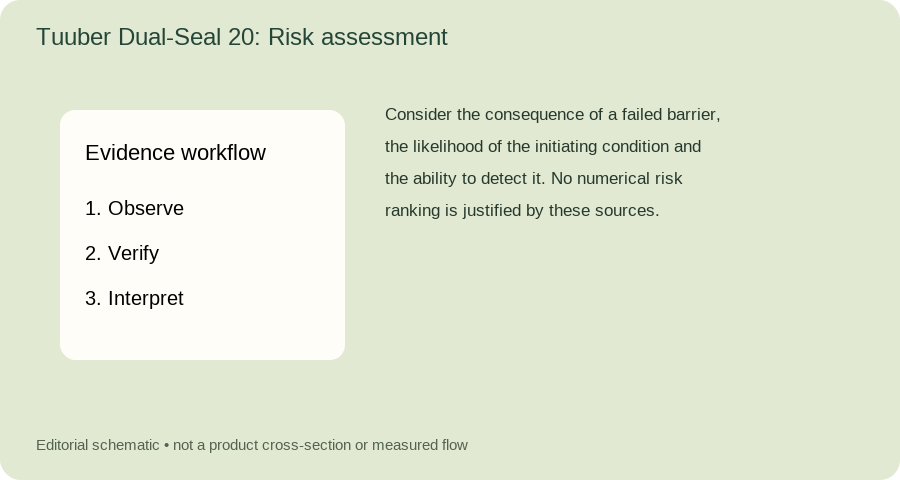
Consider the consequence of a failed barrier, the likelihood of the initiating condition and the ability to detect it. No numerical risk ranking is justified by these sources.
Editorial conclusion
Redundancy is a plausible design advantage, not verified comparative performance. The reported Tuuber test has no attached report. Treat this as an editorial interpretation, not a signed engineering opinion or independent product certification.
Source and verification
Supplied 2017 pressure differential reports (Lab 33972), custom protocol and conversation, and supplied installation, brand comparison and dual-seal articles. See evidence policy and data.