Technical context
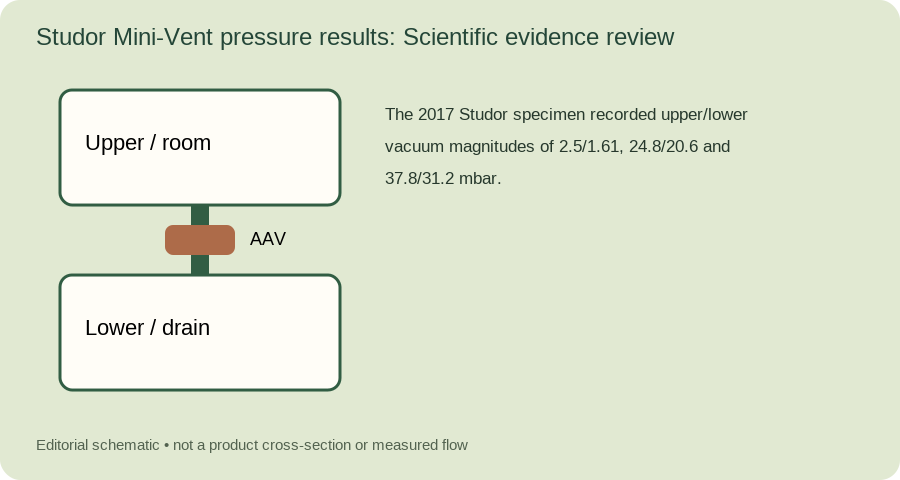
At the highest negative reading the upper chamber was 37.8 mbar and the lower 31.2 mbar in vacuum magnitude.
How to evaluate the evidence
The difference is 6.6 mbar or 660 Pa; the lower-to-upper magnitude ratio is 82.5%.
Practical verification
One specimen and no flow-time record cannot establish a population failure rate or gas exposure.
What the evidence supports
The largest measured chamber difference was 6.6 mbar. This is not a leakage rate.
Scientific evidence review perspective
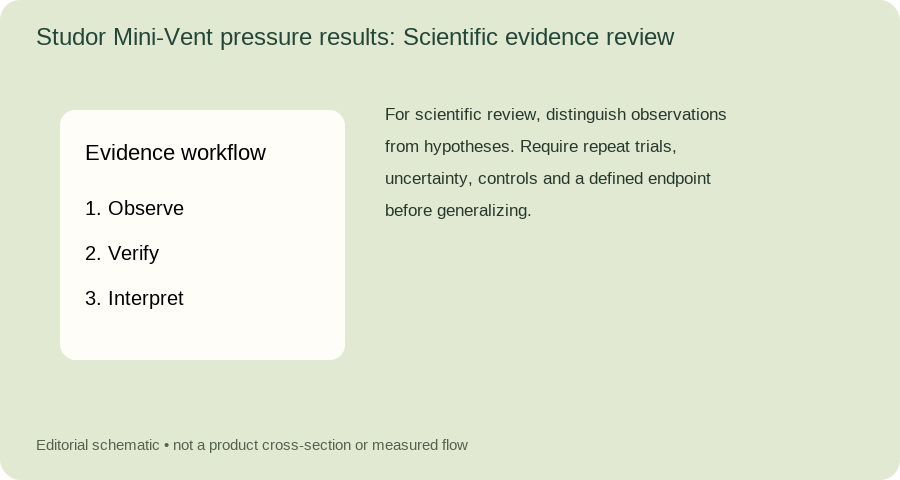
For scientific review, distinguish observations from hypotheses. Require repeat trials, uncertainty, controls and a defined endpoint before generalizing.
Editorial conclusion
The largest measured chamber difference was 6.6 mbar. This is not a leakage rate. Treat this as an editorial interpretation, not a signed engineering opinion or independent product certification.
Source and verification
Supplied 2017 pressure differential reports (Lab 33972), custom protocol and conversation, and supplied installation, brand comparison and dual-seal articles. See evidence policy and data.