Technical context
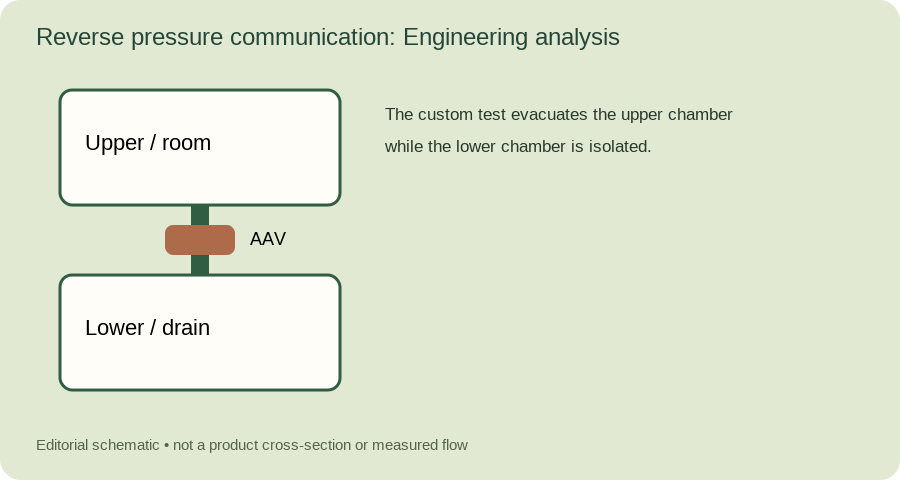
When the room-side gauge pressure is more negative than the drain side, the pressure gradient favors drain-to-room flow if a path exists.
How to evaluate the evidence
For signed pressures −3780 and −3120 Pa, drain minus room equals +660 Pa.
Practical verification
Exclude fixture bypasses and measure flow direction before claiming transport through the valve itself.
What the evidence supports
A lower chamber pressure change is consistent with reverse communication if fixture leakage and other effects are excluded.
Engineering analysis perspective
For engineering review, define signed gauge pressures, boundary conditions and the measured response. Separate pressure communication from volumetric flow and identify alternative explanations.
Editorial conclusion
A lower chamber pressure change is consistent with reverse communication if fixture leakage and other effects are excluded. Treat this as an editorial interpretation, not a signed engineering opinion or independent product certification.
Source and verification
Supplied 2017 pressure differential reports (Lab 33972), custom protocol and conversation, and supplied installation, brand comparison and dual-seal articles. See evidence policy and data.